
Connect. Secure. Manage.
Cisco AI Ethernet Fabric Design
Design a Cisco Ethernet fabric for defined AI traffic patterns, checking endpoint requirements, topology, supported speeds and failure behaviour.
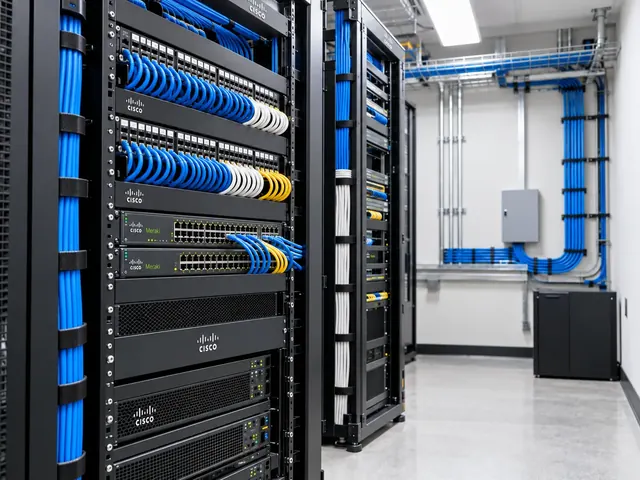
Devices supported
across the UK
Client locations
supported
Traffic handled
at peak time
Average
response time
Average response is not a resolution time or a contractual guarantee. Support scope and response commitments are agreed for each engagement.
Cisco AI Ethernet fabric design plans how compute nodes, storage and other systems will connect. We work with the platform team to understand traffic and the effect of faults or congestion. The resulting design sets out the links, traffic controls and tests. Each choice must fit the supported equipment and the workload.
Workload-led design
Start with application, compute and storage dependencies rather than the switch model.
Clear failure domains
Understand which links, devices and sites can fail together.
Operational clarity
Make fabrics, external routing and management responsibilities supportable.
Begin with the workload communication pattern
We find the flows between compute nodes, accelerators, storage and app users. Distributed communication can create synchronised bursts that are not visible in a simple average-bandwidth calculation. The number of concurrent jobs and the placement of their participating nodes influence which paths become busy together.
The design records these assumptions and the evidence supporting them. Where representative measurements are unavailable, we define a pilot to test the important uncertainties. This avoids buying a topology around an unsupported claim that every workload will spread evenly across all available links.

Standards & partnerships
Confidence in the team behind your network.
 Cisco Partner
 Cisco Meraki
 Cyber Essentials
 Cyber Essentials Plus
MCI Network Services is operated by Proxar Ltd. Certifications apply to the certified legal entity and the scope of its certificates. View accreditation information
Choose topology and capacity together
Leaf-and-spine designs can provide predictable network access. But the number and speed of links still require a workload-specific decision. We examine node placement, rack layout, available port combinations and the consequences of oversubscription. Expansion should be considered before the initial fabric consumes every practical uplink or optical connection.
We also model the remaining capacity after an agreed failure. A design that meets the normal throughput need may become unsuitable when one spine or link is unavailable. The customer should understand whether degraded operation means reduced job throughput, restricted concurrency or interruption of a service, rather than receiving an unqualified resilience claim.

A useful starting point
Not sure where to start?
Bring the requirement. We will help you define the engineering work.
Verify the complete component combination
Cisco switch support, software capabilities, network adapters, optics and cabling are reviewed together. We confirm the intended link speeds and breakout arrangements and identify any restrictions on features operating simultaneously. Platform compatibility is checked for the chosen rollout, not inferred from another rollout using a similar product family.
Physical planning covers rack position, cable routes, power and replacement access. Labelling must let an engineer locate a specific high-speed link without disturbing neighbouring connections. These details become increasingly important when a dense fabric has many similar cables and a fault must be repaired within a controlled maintenance window.

Different environments. The same care.
Built around the work
your network supports.
Finance, banking and the wider private sector. We start with the systems and people that depend on your connections.
Finance & banking
Market-data paths, routing and provider coordination on clients’ behalf.
Financial-market services ↗Offices & multi-site teams
Reliable access between people, workplaces and business applications.
Office network design ↗Data centres & cloud
Network boundaries, workload connections and operational ownership.
Data centre networks ↗Define transport and congestion behaviour
We agree whether the workload uses TCP, RoCE or a supported mixture, and which traffic classes need different treatment. Queue allocation, marking and congestion feedback are developed from endpoint needs and the capabilities of the network. A setup should explain the purpose of each class rather than assigning every important app the highest priority.
Where PFC or ECN is proposed, the design includes its scope, endpoint interaction and validation method. These mechanisms have operational trade-offs and cannot be treated as guarantees that packets will never be dropped. Our PFC and ECN tuning work examines their behaviour under representative load and during recovery.

Keep the fabric integrated but controlled
The workload fabric must connect to management, storage and enterprise services without creating accidental shared failure domains. We document routing boundaries, required infrastructure services and any inspection points. Traffic that does not need access to the wider business network should not acquire it merely because the fabric has an external uplink.
Administrative responsibility is equally important. The design sets out who controls switch setup, endpoint settings and workload scheduling, and how changes are coordinated. A platform team increasing job concurrency can alter network conditions even without a networking change, so capacity and incident reviews need participation from both sides.

Design observability before commissioning
The proposed monitoring identifies errors, queue conditions, path usage and the events that show loss of resilience. We specify what evidence is available from the chosen Cisco platforms and how it will be correlated with job timing. A dashboard of link-up states is insufficient for investigating a cluster that completes work slowly.
Acceptance tests include representative workload runs, chosen congestion cases and safe failure scenarios. The test plan distinguishes network throughput from app completion time and records any limits of the test setup. Results should be repeatable enough to support future expansion decisions rather than representing a single favourable demonstration.

Deliver a design that can be operated
The final package can include physical and logical diagrams, addressing, port assignments, supported settings, capacity assumptions and a rollout sequence. It also records rollback boundaries and actions that require platform-owner approval. The aim is a design another competent engineer can implement and maintain.
MCI provides specialist Cisco networking services across the UK. We can begin with AI network readiness or work from an agreed platform specification. The engagement remains focused on networking; accelerator software, model performance and storage administration need their own named owners and acceptance criteria.
Talk to a specialist
What does your network need next?
Tell us what you are planning, changing or trying to improve. We will help define a practical next step and the engineering scope.
+44 203 196 6566Choose option 1
sales@proxar.co.ukUK-wide service.
Most of our engineers are based in Kent, with a focus on London, Sussex, Essex and Berkshire.
Existing customers should use their agreed support and escalation channels. This form is for service enquiries, not a monitored emergency ticket.
Tell us what you need.
A short outline is enough. Please do not include passwords or sensitive network details.
Thank you. Your enquiry has been submitted.
Please check your name, email and message, then try again.
Your form session expired. Please try again.
Please wait a minute before sending another enquiry.
We could not submit your enquiry. Please call or email us instead.