
Connect. Secure. Manage.
WAN Failover Testing
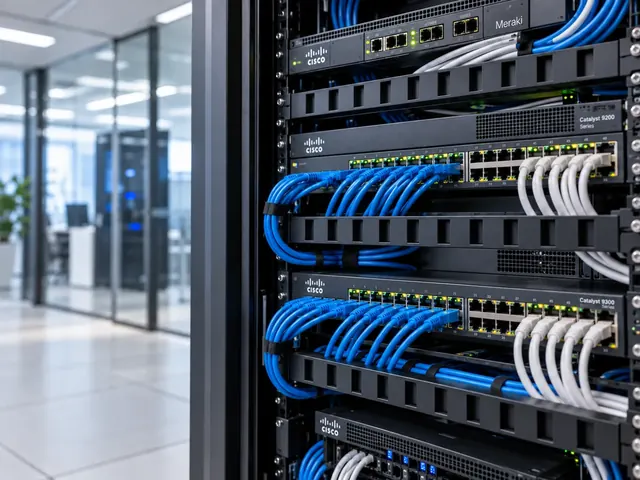
Exercise agreed WAN failure scenarios on Cisco or Meraki networks, measuring recovery behaviour and checking whether important applications remain usable.
Devices supported
across the UK
Client locations
supported
Traffic handled
at peak time
Average
response time
Average response is not a resolution time or a contractual guarantee. Support scope and response commitments are agreed for each engagement.
WAN failover testing answers a practical question: when the preferred connection fails, can people still do the work that matters? A second circuit and a green dashboard are not enough to answer it. MCI Network Services tests Cisco and Meraki WAN designs against agreed failure scenarios, recording what happened to routing, security sessions and business applications rather than declaring success because a backup interface became active.
The whole path
Understand how sites, providers, cloud networks and security controls fit together.
Resilience that can be tested
Separate a second circuit from genuine end-to-end service resilience.
Provider coordination
Keep addressing, routing and escalation ownership clear across organisations.
Agree what a successful recovery looks like
Different services tolerate different interruptions. A document upload may retry without anyone noticing, while a voice call, payment session or market-data application may react immediately. We agree representative transactions with the application owners before touching the network. The acceptance record defines the permitted interruption, the functions that must remain available and any session that is expected to reconnect.
The test also needs a clear boundary. We identify the site, circuits, edge devices, tunnels, internet exits and cloud destinations involved. Tests limited to one office do not establish resilience across the whole business. Where an application cannot safely be exercised, that limitation is written into the result rather than concealed behind a general availability statement.

Standards & partnerships
Confidence in the team behind your network.
 Cisco Partner
 Cisco Meraki
 Cyber Essentials
 Cyber Essentials Plus
MCI Network Services is operated by Proxar Ltd. Certifications apply to the certified legal entity and the scope of its certificates. View accreditation information
Choose failures that expose different weaknesses
Disconnecting an Ethernet cable tests a local link-down event. It does not reproduce a carrier fault where the local interface stays up, a routing neighbour fails beyond the handoff or packet loss makes a circuit unusable. We select scenarios that reflect the actual design and the risks identified during the WAN resilience assessment.
For supported Cisco or Meraki environments, the scope may include loss of a circuit, loss of an edge device, withdrawal of a relevant route and degradation of the preferred path. We do not inject uncontrolled faults into a live service. Each exercise has an authorised method, an accountable engineer and an agreed point at which testing stops.

A useful starting point
Tell us what is happening.
A short description of the problem is enough for an initial discussion.
Protect access before creating a fault
The engineer must not depend solely on the connection being interrupted. We review alternative management access, local assistance, console availability and the ability to reverse the change. Configuration exports, current diagrams and supplier contacts are checked before the window begins. A backup that cannot be reached during the failure does little to help recovery.
The preparation identifies shared dependencies that could turn a limited test into a wider outage. These include common power supplies, aggregation switches, firewalls and remote VPN hubs. We also agree who can authorise rollback and how users will be informed if the observed impact exceeds the planned interruption. The test window is not the time to discover that the decision-maker is unavailable.

Different environments. The same care.
Built around the work
your network supports.
Finance, banking and the wider private sector. We start with the systems and people that depend on your connections.
Finance & banking
Market-data paths, routing and provider coordination on clients’ behalf.
Financial-market services ↗Offices & multi-site teams
Reliable access between people, workplaces and business applications.
Office network design ↗Data centres & cloud
Network boundaries, workload connections and operational ownership.
Data centre networks ↗Measure forwarding and applications together
During each scenario we capture the timing of fault detection, path change and application recovery. Cisco routing state, Meraki uplink events, tunnel status and representative traffic tests provide different pieces of evidence. We correlate them against a common timeline and retain enough detail to explain the result without collecting unnecessary customer data.
Stateful inspection and address translation deserve particular attention. A route may recover while an existing connection remains tied to the former path or public address. We test new connections as well as established ones and verify the return route. This distinguishes a routing problem from expected session re-establishment or an application that has not retried correctly.

Check capacity in the degraded state
A backup circuit can carry basic probes and still be too small for the business. We compare the surviving capacity with the traffic expected during an incident. Where appropriate, testing includes a controlled representative load and checks that priority applications remain usable without allowing bulk traffic to monopolise the reduced bandwidth.
Cellular backups need additional care because signal quality, provider routing and available capacity can vary. An observed result is recorded with its conditions; it is not converted into a permanent bandwidth promise. Any temporary restrictions needed during failover become part of the operating procedure, with a clear owner for enabling and removing them.

Test restoration as carefully as failure
Returning the preferred path can cause another interruption. We observe whether traffic moves back automatically, whether existing sessions remain stable and whether routing or tunnel state settles as expected. Repeated switching between paths is investigated rather than accepted as normal resilience behaviour. Recovery should leave a predictable operating state, not merely end the alarm.
You receive a test record, exceptions, supporting evidence and prioritised actions. We can then help correct the identified design or operational weaknesses and repeat the affected scenarios. MCI’s Cisco and Meraki network services cover UK sites, with on-site arrangements agreed for the location. For a proposal, share the topology, important applications and the failure cases you need to prove.

Talk to a specialist
Need a specialist view?
Tell us what is affected, what changed and what your team has already checked. A short outline is enough to start.
+44 203 196 6566Choose option 1
sales@proxar.co.ukUK-wide service.
Most of our engineers are based in Kent, with a focus on London, Sussex, Essex and Berkshire.
Existing customers should use their agreed support and escalation channels. This form is for service enquiries, not a monitored emergency ticket.
Tell us what you need.
A short outline is enough. Please do not include passwords or sensitive network details.
Thank you. Your enquiry has been submitted.
Please check your name, email and message, then try again.
Your form session expired. Please try again.
Please wait a minute before sending another enquiry.
We could not submit your enquiry. Please call or email us instead.