
Connect. Secure. Manage.
Guest Wireless
Provide usable guest Wi-Fi on Cisco and Meraki networks with appropriate separation, access policies and privacy information for visitors.
Devices supported
across the UK
Client locations
supported
Traffic handled
at peak time
Average
response time
Average response is not a resolution time or a contractual guarantee. Support scope and response commitments are agreed for each engagement.
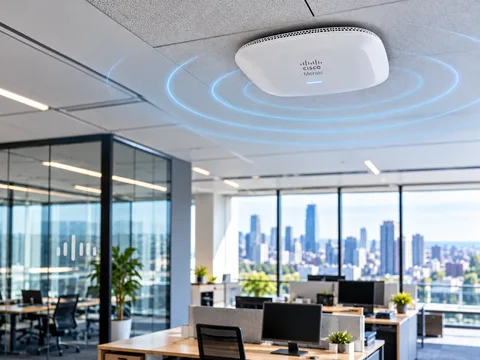
Guest wireless lets visitors connect while keeping their access separate from internal systems. We plan Cisco and Meraki Wi-Fi around the visitor journey, traffic path and support duties. The welcome page and network name are only part of the service. Access rules and the systems behind them must work together and be tested.
Coverage and capacity
Design Wi-Fi around the spaces, devices and traffic that depend on it.
Secure access
Align authentication, segmentation and guest access with the wider network.
Measured performance
Validate roaming, interference and user experience instead of relying on signal bars.
Decide who the guest service is for
Visitors, contractors and personal staff devices may all be described as guests. But they do not necessarily need the same access. We set out the intended user groups and the apps they should reach. A meeting visitor may need internet access only, while a contractor requiring an internal portal needs a separately authorised arrangement. Combining those needs without review can create unnecessary exposure.
We also establish how access should be granted and supported. Reception, a sponsor or a self-service process may have different operational implications. The customer should know who can help a visitor who cannot connect and how access is withdrawn when no longer needed. The design avoids making the technical team the accidental owner of a visitor-management process that nobody has agreed to operate.
Standards & partnerships
Confidence in the team behind your network.
 Cisco Partner
 Cisco Meraki
 Cyber Essentials
 Cyber Essentials Plus
MCI Network Services is operated by Proxar Ltd. Certifications apply to the certified legal entity and the scope of its certificates. View accreditation information
Choose the forwarding and isolation model
Guest traffic can be handled through several supported Cisco or Meraki arrangements, depending on the architecture and need. We assess local breakout, central termination and relevant addressing modes, then document where traffic reaches a gateway and firewall. The chosen model should provide the intended service without relying on accidental separation created by a device’s default setup.
Client isolation and protection of the wired network are reviewed separately. For example, basic isolation between wireless clients does not by itself establish that internal wired destinations are blocked. We test the actual policy and forwarding path. Required DNS, portal and internet services are permitted deliberately, while access to management and corporate networks is constrained according to the approved design.

A useful starting point
Not sure where to start?
Bring the requirement. We will help you define the engineering work.
Make onboarding understandable and proportionate
The connection process should be appropriate for the audience and the customer’s operating model. We review whether a portal, sponsorship, credentials or another supported method is genuinely needed. Additional steps can create support work without improving the intended security outcome. The aim is a usable process with clear ownership, not the most elaborate welcome screen the platform can display.
Where information is collected, the customer must define why it is needed, who can access it and how long it is retained. We align the technical workflow with the approved privacy information and access process, without treating use of guest Wi-Fi as automatic permission for unrelated marketing. Exact legal wording and retention commitments must reflect the customer’s real activities rather than a generic portal template.

Different environments. The same care.
Built around the work
your network supports.
Finance, banking and the wider private sector. We start with the systems and people that depend on your connections.
Finance & banking
Market-data paths, routing and provider coordination on clients’ behalf.
Financial-market services ↗Offices & multi-site teams
Reliable access between people, workplaces and business applications.
Office network design ↗Data centres & cloud
Network boundaries, workload connections and operational ownership.
Data centre networks ↗Plan capacity without undermining business traffic
Guest demand is assessed alongside the rest of the wireless estate. A conference room, training event or public reception can create a different load from ordinary office visitors. We review coverage, airtime, internet capacity and any appropriate traffic limits. The aim is to provide a useful visitor service while preserving the needs of staff and operational apps.
Limits are tested with realistic activities rather than chosen solely because a platform offers a convenient default. Excessively restrictive settings can make authentication, collaboration or ordinary browsing appear unreliable. We also consider how many SSIDs are necessary, since each extra wireless service has operational and radio implications. The design should remain manageable as visitor numbers or building use change.

Test the whole visitor journey
Acceptance starts with a device that has not previously connected. We test discovery, onboarding, address assignment, name resolution and representative internet use. Different operating systems can handle captive portals and browser prompts differently. So the agreed client matrix matters. A successful test on an administrator’s already-authorised laptop is not enough evidence of a working visitor experience.
Security testing confirms that prohibited internal paths remain unavailable and that any approved exceptions are narrow and documented. We also check access expiry or withdrawal where it forms part of the design. Failure scenarios, such as an unavailable portal or identity service, are considered clearly so reception and support staff know what to tell visitors rather than improvising an insecure workaround during an incident.

Keep the service accountable after launch
The handover includes the access process, policy boundary, support duties and relevant monitoring. Administrative rights are limited to the roles that need them, with a documented route for exceptions. Changes to firewalls, portals or client-addressing modes should trigger a review of the guest assumptions, because a small change to the settings can alter the actual separation from internal networks.
MCI provides Cisco and Meraki network services throughout the UK. Our guest Wi-Fi network design service can establish the architecture, while Cisco guest anchoring addresses a specific centralised arrangement. Share the visitor groups, sites and intended access process so we can define a practical service rather than simply adding another wireless network name.
Technical references
- Guest and internal wireless network configuration — Cisco / Cisco Meraki
- Wireless access control — Cisco / Cisco Meraki
- Wireless client isolation — Cisco / Cisco Meraki
Talk to a specialist
What does your network need next?
Tell us what you are planning, changing or trying to improve. We will help define a practical next step and the engineering scope.
+44 203 196 6566Choose option 1
sales@proxar.co.ukUK-wide service.
Most of our engineers are based in Kent, with a focus on London, Sussex, Essex and Berkshire.
Existing customers should use their agreed support and escalation channels. This form is for service enquiries, not a monitored emergency ticket.
Tell us what you need.
A short outline is enough. Please do not include passwords or sensitive network details.
Thank you. Your enquiry has been submitted.
Please check your name, email and message, then try again.
Your form session expired. Please try again.
Please wait a minute before sending another enquiry.
We could not submit your enquiry. Please call or email us instead.