
Connect. Secure. Manage.
Catalyst Switch Stacking
Configure Cisco switch stacks with compatible software, resilient cabling and recovery procedures that account for member failure and replacement.
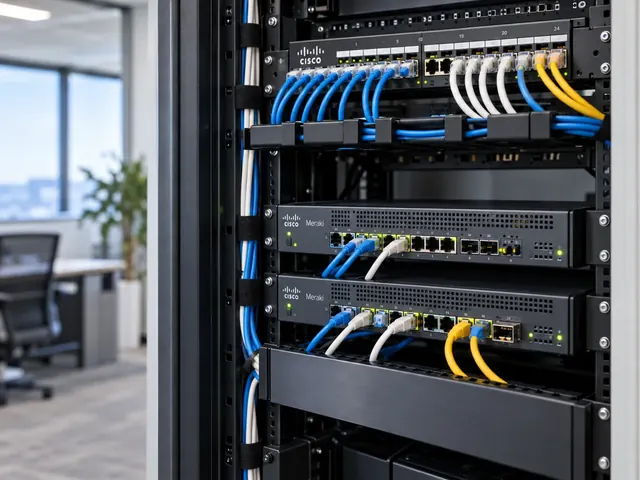
Devices supported
across the UK
Client locations
supported
Traffic handled
at peak time
Average
response time
Average response is not a resolution time or a contractual guarantee. Support scope and response commitments are agreed for each engagement.
Catalyst switch stacking can make a group of switches easier to manage. It also creates shared points of control that need care. We help you choose and set up a supported stack, then check how it behaves when a link or unit fails. Planned maintenance and recovery are part of that work.
Cisco-focused engineering
Design around the platform, traffic and failure behaviour you actually operate.
Change with evidence
Use pre-checks, acceptance criteria and a documented route back.
Operational handover
Keep the configuration, diagrams and responsibilities understandable after delivery.
When a stack makes sense
A stack allows compatible physical switches to operate as one logical system, subject to the capabilities and restrictions of the particular Catalyst family. This can reduce the number of individually managed devices and make it easier to provide uplinks or port capacity across a group of switches. It may also introduce dependencies between members that would not exist with independently managed equipment.
The starting point is the business need. We ask whether the aim is extra access ports, simpler management, resilient connections, easier replacement or a combination of these. The answer influences the appropriate topology. A stack that is convenient for a single wiring cabinet may not be appropriate across physically separated areas with different power and maintenance arrangements.

Standards & partnerships
Confidence in the team behind your network.
 Cisco Partner
 Cisco Meraki
 Cyber Essentials
 Cyber Essentials Plus
MCI Network Services is operated by Proxar Ltd. Certifications apply to the certified legal entity and the scope of its certificates. View accreditation information
Verify hardware and software compatibility
Not every Catalyst model can be stacked with every other model. Before specifying hardware, we confirm the supported platform family, stack technology, member limits, software needs and any restrictions affecting uplinks or licensing. We also check the available stacking modules and cables, their physical routing and whether the rack layout allows members to be replaced safely.
Mixed hardware generations deserve particular scrutiny. A setup that appears compatible at the feature level may have operational limitations during an upgrade or failover. We document the supported combination and identify any assumptions that need testing. Where a customer’s current switches cannot form a supported stack, the right answer may be independent switches with an appropriate upstream design rather than an improvised setup.

A useful starting point
Not sure where to start?
Bring the requirement. We will help you define the engineering work.
Design the stack topology
The physical stacking topology influences both capacity and fault tolerance. We review the intended ring or other supported arrangement, cable lengths, member placement and the effect of a failed link. Where the platform supports it, a complete ring can provide an alternative path after a stack-link fault. But the remaining bandwidth and the specific recovery behaviour still require verification.
Power is a separate consideration. Two switches in one stack are not resilient if they depend on the same failed power feed. We assess power supplies, rack distribution, environmental conditions and, where applicable, supported power-sharing features. Resilience claims should describe the complete service path, including access links, uplinks, gateways and upstream security devices.

Different environments. The same care.
Built around the work
your network supports.
Finance, banking and the wider private sector. We start with the systems and people that depend on your connections.
Finance & banking
Market-data paths, routing and provider coordination on clients’ behalf.
Financial-market services ↗Offices & multi-site teams
Reliable access between people, workplaces and business applications.
Office network design ↗Data centres & cloud
Network boundaries, workload connections and operational ownership.
Data centre networks ↗Understand control-plane and maintenance risks
A logical stack has shared operational characteristics. A software upgrade or control-plane incident can affect more than one physical member, depending on the platform and change procedure. We explain that risk to customers who assume multiple boxes automatically mean independent failure domains.
We also establish the process for adding or replacing a member. Member numbering, switch priority, software alignment and interface identification can affect setup persistence and port mappings. A replacement should follow a documented process, including backup of the settings and validation, rather than relying on a technician to improvise during an outage.

Configure uplinks and access services
Stacking changes how ports are presented. But it does not remove the need for sound Layer 2 and Layer 3 design. We check VLANs, trunks, link aggregation, spanning-tree behaviour and the placement of routed gateways. If uplinks are spread across members, the intended failure path must be supported and tested.
For access stacks, we review Power over Ethernet budgets, authentication policies, voice VLANs and the effects of member loss on connected devices. A failed member will still disconnect endpoints attached to its physical ports. Stacking may improve uplink or management resilience without providing endpoint-level continuity. That distinction matters when discussing service availability with a business owner.

Test the behaviour before handover
Acceptance testing should reflect the design aims. Depending on the agreed scope, we check member discovery, stack health, software alignment, uplink status, expected failover and restoration behaviour. Tests involving a member restart or stack-link disconnection need an agreed maintenance window and a safe rollback plan.
We also check management access, monitoring alerts, interface descriptions and backups of the settings. The operations team should be able to identify which physical member hosts a reported port, understand how a replacement will affect the stack and find the correct escalation procedure. Clear records are especially important in larger estates with similar-looking cabinets.

Ongoing management and support
A stack should be included in the network lifecycle plan. We track software support, hardware availability, capacity growth and changes to the settings that could affect multiple members. Monitoring needs to distinguish a single interface problem from a stack-wide event, and incident procedures should avoid making an unstable situation worse through unnecessary restarts.
MCI provides Cisco and Meraki network services throughout the UK, particularly London, Kent, Sussex, Essex and Berkshire. If you are planning a Catalyst refresh or reviewing a current stack, share the models, topology and the failures you need to withstand. We can assess the design, define acceptance tests and agree the support duties before any change is made.
Talk to a specialist
What does your network need next?
Tell us what you are planning, changing or trying to improve. We will help define a practical next step and the engineering scope.
+44 203 196 6566Choose option 1
sales@proxar.co.ukUK-wide service.
Most of our engineers are based in Kent, with a focus on London, Sussex, Essex and Berkshire.
Existing customers should use their agreed support and escalation channels. This form is for service enquiries, not a monitored emergency ticket.
Tell us what you need.
A short outline is enough. Please do not include passwords or sensitive network details.
Thank you. Your enquiry has been submitted.
Please check your name, email and message, then try again.
Your form session expired. Please try again.
Please wait a minute before sending another enquiry.
We could not submit your enquiry. Please call or email us instead.