
Connect. Secure. Manage.
Data Centre Disaster Recovery Networking
Plan the network elements of data centre recovery, coordinating addressing, routing changes and access to applications during a declared failover.
Devices supported
across the UK
Client locations
supported
Traffic handled
at peak time
Average
response time
Average response is not a resolution time or a contractual guarantee. Support scope and response commitments are agreed for each engagement.
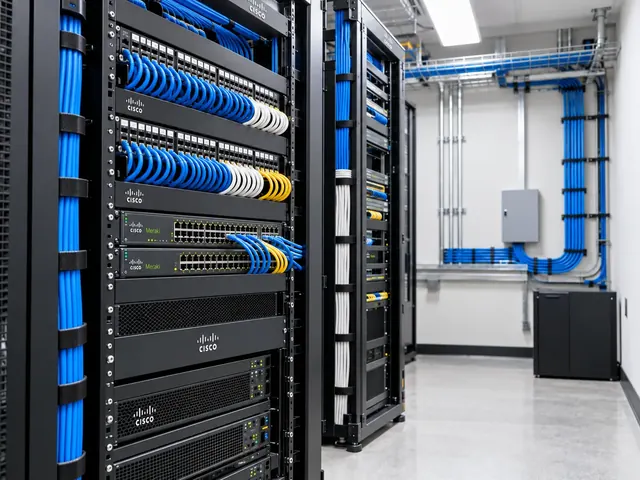
Data centre disaster recovery networking prepares the paths needed when apps move or restart after a serious site fault. We plan network routes, address changes and recovery access with the wider service teams. This supports their recovery plan. It does not replace the separate work needed to protect apps and data.
Workload-led design
Start with application, compute and storage dependencies rather than the switch model.
Clear failure domains
Understand which links, devices and sites can fail together.
Operational clarity
Make fabrics, external routing and management responsibilities supportable.
Connect network scope to the business recovery plan
We find the services to be recovered, their priorities and the customer’s agreed recovery aims. The network work follows those needs rather than inventing an availability target. Application, storage and business owners define when a service is safe to activate and what data state is acceptable. The network team provides the network access and evidence needed to support that decision.
The dependency map includes identity, DNS, management, monitoring, security services and external counterparties. A recovered app may still be unusable if one of these remains at the failed site. We distinguish essential dependencies from functions that can be deferred and document ownership. This creates a realistic recovery sequence rather than a diagram that shows only a second data centre and a replication link.

Standards & partnerships
Confidence in the team behind your network.
 Cisco Partner
 Cisco Meraki
 Cyber Essentials
 Cyber Essentials Plus
MCI Network Services is operated by Proxar Ltd. Certifications apply to the certified legal entity and the scope of its certificates. View accreditation information
Design addressing and routing for the recovery state
The plan establishes whether workloads retain addresses, use different networks or rely on another supported transition method. Each choice affects gateways, routes, firewall rules and app references. We assess the implications with the platform teams before deciding how the Cisco network should present the recovered service.
External network access needs equal attention. Public addresses, private peerings, partner allowlists and cloud routes may not follow a workload automatically. We document who can authorise changes and which providers must participate. A route advertised from a recovery site must represent a service that is ready to receive traffic, not simply a network interface that has become active.

A useful starting point
Not sure where to start?
Bring the requirement. We will help you define the engineering work.
Preserve security and administrative access
Recovery should not require removing essential controls simply to make an app reachable. We review firewall policy, remote access, management paths and credential availability for the recovery setup. Approved emergency access is documented and tested where practical, with audit and removal procedures for any temporary exception.
The operations team needs access that does not depend entirely on the failed site. We examine identity, secrets storage, communication channels and out-of-band arrangements. Sensitive recovery material is protected but must remain accessible to authorised responders. A secure backup that no one can retrieve during the incident does not provide a usable recovery capability.

Different environments. The same care.
Built around the work
your network supports.
Finance, banking and the wider private sector. We start with the systems and people that depend on your connections.
Finance & banking
Market-data paths, routing and provider coordination on clients’ behalf.
Financial-market services ↗Offices & multi-site teams
Reliable access between people, workplaces and business applications.
Office network design ↗Data centres & cloud
Network boundaries, workload connections and operational ownership.
Data centre networks ↗Plan capacity and shared dependencies
The recovery location may need to carry traffic normally distributed across several sites. We assess network, interconnect and security-device capacity for the agreed recovered workload set. The plan sets out any service restrictions or prioritisation needed in the degraded state. Normal low usage at the standby site is not evidence that it can support the full recovery load.
We also review shared carrier routes, power and management dependencies that could affect both locations. Where independence is assumed, the supporting evidence is recorded. The network design cannot eliminate every common risk. But it should make the residual dependencies clear enough for the business to accept or address them deliberately.

Exercise recovery and failback safely
A tabletop review can check duties and decision points before a technical exercise. Where authorised, testing then shows the network changes, app access and monitoring required for recovery. The scope is bounded to avoid creating an uncontrolled production outage. Results distinguish simulated steps from actions actually performed against the setup.
Failback is planned separately. Returning to the original site may depend on app state, data reconciliation and provider changes, not just restoring the former routes. We set out the conditions for proceeding and the people who approve them. A recovery runbook should not force traffic back automatically before the wider service is ready.

Deliver a practical recovery record
The handover includes network diagrams for normal and recovery states, route and policy changes, provider contacts, verification steps and stop conditions. Each dependency has an owner. Exercise findings become prioritised actions with a way to confirm completion, rather than remaining as general lessons that are forgotten before the next test.
MCI can design recovery networking or review a current plan alongside your app and infrastructure teams. Related services include data centre interconnects and network recovery exercises. Provide the service priorities, locations and current recovery approach to begin. The proposal will state the network deliverables and the wider decisions required for a complete business recovery capability.

Talk to a specialist
What does your network need next?
Tell us what you are planning, changing or trying to improve. We will help define a practical next step and the engineering scope.
+44 203 196 6566Choose option 1
sales@proxar.co.ukUK-wide service.
Most of our engineers are based in Kent, with a focus on London, Sussex, Essex and Berkshire.
Existing customers should use their agreed support and escalation channels. This form is for service enquiries, not a monitored emergency ticket.
Tell us what you need.
A short outline is enough. Please do not include passwords or sensitive network details.
Thank you. Your enquiry has been submitted.
Please check your name, email and message, then try again.
Your form session expired. Please try again.
Please wait a minute before sending another enquiry.
We could not submit your enquiry. Please call or email us instead.