
Connect. Secure. Manage.
Campus Gateway Roaming Design
Design wireless mobility around Campus Gateway, validating addressing and traffic continuity as representative clients move between coverage areas.

Devices supported
across the UK
Client locations
supported
Traffic handled
at peak time
Average
response time
Average response is not a resolution time or a contractual guarantee. Support scope and response commitments are agreed for each engagement.
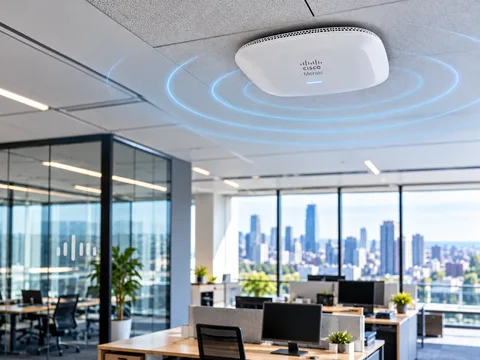
Campus Gateway roaming design connects wireless mobility requirements with the central forwarding and authentication structure needed to support them. Cisco Campus Gateway can help maintain a consistent client traffic termination across supported access-point areas, but successful application use still depends on radio coverage and client behaviour. MCI Network Services designs and tests that complete path rather than promising seamless movement solely because a central gateway has been installed.
Coverage and capacity
Design Wi-Fi around the spaces, devices and traffic that depend on it.
Secure access
Align authentication, segmentation and guest access with the wider network.
Measured performance
Validate roaming, interference and user experience instead of relying on signal bars.
Map where clients actually move
We begin with the routes taken by users and devices. Movement between meeting rooms, floors, warehouses or adjacent buildings can expose different radio and network boundaries. The design identifies the applications used during those journeys and the impact of a connection interruption. A mobile scanner transaction and an idle browser session should not be treated as equivalent acceptance tests.
We also record which clients are in scope. Wireless adapters, software and authentication methods can affect how a device transitions between access points. The project uses representative endpoints rather than relying on an engineer’s preferred test laptop. Where a specialist client has limited capabilities, its constraints are included in the design and discussed with its owner before the wider service is committed.

Standards & partnerships
Confidence in the team behind your network.
 Cisco Partner
 Cisco Meraki
 Cyber Essentials
 Cyber Essentials Plus
MCI Network Services is operated by Proxar Ltd. Certifications apply to the certified legal entity and the scope of its certificates. View accreditation information
Align the roaming domain and forwarding path
Central termination can allow clients to move across access-layer IP boundaries while retaining the intended client-network relationship in a supported deployment. We document where traffic is anchored, which gateway services remain in use and how return traffic reaches the client. That forwarding record helps distinguish a mobility issue from a routing or security problem that happens to occur during movement.
The dashboard management structure must support the intended scope. Current supported multi-network arrangements can use network groups, shared SSID profiles and common Campus Gateway clusters, subject to their prerequisites. We verify those features for the actual release and topology. Identical SSID names across separate networks are not treated as proof that key sharing, policy or fast-roaming behaviour will be equivalent.

A useful starting point
Not sure where to start?
Bring the requirement. We will help you define the engineering work.
Make RF continuity part of the architecture
A stable central data path cannot compensate for a coverage gap or unsuitable access-point placement. We review survey evidence along the actual routes, considering signal conditions, interference and overlapping cells. The client needs a usable next access point at the relevant point in its movement. An architectural diagram does not establish that this physical condition exists.
Radio settings are reviewed with client behaviour in mind. Power, channel choices and supported roaming assistance may influence the result, but the endpoint still participates in deciding when and where to move. We avoid applying aggressive settings without testing their effect on the supported device population. Our wireless surveys can supply the missing physical evidence before detailed mobility policy is finalised.
Different environments. The same care.
Built around the work
your network supports.
Finance, banking and the wider private sector. We start with the systems and people that depend on your connections.
Finance & banking
Market-data paths, routing and provider coordination on clients’ behalf.
Financial-market services ↗Offices & multi-site teams
Reliable access between people, workplaces and business applications.
Office network design ↗Data centres & cloud
Network boundaries, workload connections and operational ownership.
Data centre networks ↗Coordinate authentication and policy consistency
The authentication path must support the expected movement. We assess certificate, identity-service and key-management dependencies for the selected client and platform combinations. A full authentication exchange during movement can have a different application effect from a supported faster transition. The design records what is intended and how that behaviour will be verified.
Client policy should remain appropriate after the transition. We check addressing, access restrictions and any identity-derived assignment on both sides of the movement boundary. A client that remains connected but lands in the wrong network is not a successful roam. Corporate, guest and specialist services are tested separately where their forwarding or security requirements differ.

Test the application journey repeatedly
Acceptance follows the agreed physical route while the representative application is active. We capture timestamps, access-point changes and relevant controller or dashboard evidence, then compare them with what the user experienced. Repeated tests help distinguish a consistent boundary problem from an intermittent environmental or endpoint condition. A single successful walk-through is useful evidence but not a complete explanation of a recurring complaint.
We also test the agreed degraded conditions where safe. A gateway or uplink failure may alter the traffic path and expose a problem not seen during normal movement. The test scope identifies what was exercised and what remains untested. Results are reported as observed behaviour rather than converted into a universal guarantee that every session will survive every transition or infrastructure event.

Maintain the design as the campus changes
The handover records the mobility areas, forwarding relationships, client matrix and acceptance routes. New buildings, network groups or SSID changes should be reviewed against that baseline. A local administrative change can affect a shared mobility domain, so ownership and approval rules are made explicit for the teams that will operate the service.
MCI can include this work within a Campus Gateway deployment or investigate an existing mobility problem. Share the affected routes, client types and applications, along with the current gateway and dashboard structure. We will define the necessary radio, identity and forwarding checks so the resulting design addresses the user’s journey rather than only the health of the infrastructure at either end.
Technical references
- Campus Gateway multi-network deployment — Cisco / Cisco Meraki
- Roaming technologies — Cisco / Cisco Meraki
Talk to a specialist
What does your network need next?
Tell us what you are planning, changing or trying to improve. We will help define a practical next step and the engineering scope.
+44 203 196 6566Choose option 1
sales@proxar.co.ukUK-wide service.
Most of our engineers are based in Kent, with a focus on London, Sussex, Essex and Berkshire.
Existing customers should use their agreed support and escalation channels. This form is for service enquiries, not a monitored emergency ticket.
Tell us what you need.
A short outline is enough. Please do not include passwords or sensitive network details.
Thank you. Your enquiry has been submitted.
Please check your name, email and message, then try again.
Your form session expired. Please try again.
Please wait a minute before sending another enquiry.
We could not submit your enquiry. Please call or email us instead.