
Connect. Secure. Manage.
Legacy Network Equipment Integration
Keep retained D-Link and other legacy equipment within an agreed Cisco or Meraki design, documenting limitations, isolation needs and replacement priorities.
Devices supported
across the UK
Client locations
supported
Traffic handled
at peak time
Average
response time
Average response is not a resolution time or a contractual guarantee. Support scope and response commitments are agreed for each engagement.
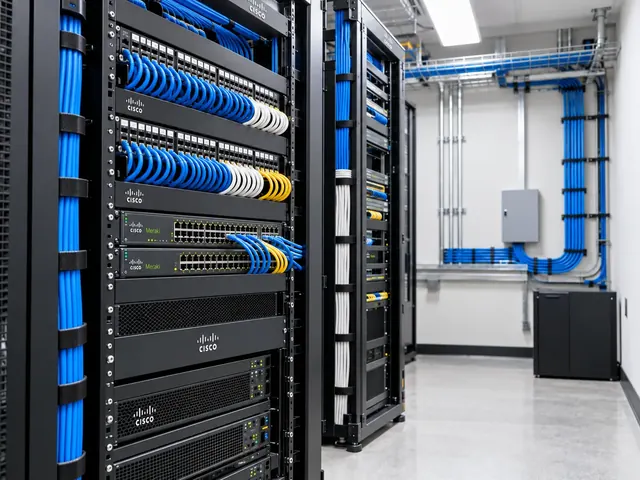
Legacy network equipment integration gives older or less familiar devices a carefully defined place within a Cisco or Meraki environment. MCI helps assess what the equipment still needs to do, which connections it depends on and whether retaining it is reasonable. The aim is to avoid both unnecessary replacement and the uncontrolled extension of a device beyond a supportable role.
A legacy estate can include specialist appliances, inherited switches or equipment from vendors such as D-Link. The label does not automatically mean the device is unusable. It does mean that capability, support, documentation and security assumptions deserve explicit review.
A clear requirement
Turn the business need into a practical network scope with visible dependencies.
A controlled delivery
Plan implementation, testing and rollback before production changes begin.
A supportable result
Leave useful records, ownership and escalation routes behind.
Establish the role that cannot yet move
We begin with the business dependency. A device may support a specialist application, a contractual handoff or equipment that cannot be changed during the current project.
Understanding that dependency prevents the assessment from becoming a simple age comparison. The cost and risk of immediate replacement need to be weighed against the limitations of keeping the existing platform.
The retained role should be narrow and clear. If the equipment is needed for one service, the new design should not casually make it responsible for additional critical traffic simply because spare ports are available.

Standards & partnerships
Confidence in the team behind your network.
 Cisco Partner
 Cisco Meraki
 Cyber Essentials
 Cyber Essentials Plus
MCI Network Services is operated by Proxar Ltd. Certifications apply to the certified legal entity and the scope of its certificates. View accreditation information
Check what is known about the equipment
An accurate model, software version and configuration record are important starting points. We review available product information and distinguish confirmed capabilities from assumptions based on similar equipment.
Support and lifecycle status need specific evidence. A device still operating in production is not proof that software updates, replacement parts or manufacturer assistance remain available.
Where information cannot be recovered, that uncertainty becomes part of the decision. We do not turn undocumented behaviour into a compatibility guarantee or claim to certify unsupported hardware by connecting it to a newer network.

A useful starting point
Not sure where to start?
Bring the requirement. We will help you define the engineering work.
Define a controlled connection
The integration design identifies the minimum traffic and management access required. A retained system may need separation from broader user or administrative networks, depending on its role and assessed risks.
The surrounding Cisco or Meraki infrastructure can provide a clear boundary, but it cannot automatically compensate for every weakness inside the older equipment. Any remaining risk needs an explicit owner and an informed acceptance decision.
Physical connections, link behaviour and relevant protocols are checked against the actual platform. The fact that two ports can establish a link does not prove that the complete service will behave correctly under load or during recovery.

Different environments. The same care.
Built around the work
your network supports.
Finance, banking and the wider private sector. We start with the systems and people that depend on your connections.
Finance & banking
Market-data paths, routing and provider coordination on clients’ behalf.
Financial-market services ↗Offices & multi-site teams
Reliable access between people, workplaces and business applications.
Office network design ↗Data centres & cloud
Network boundaries, workload connections and operational ownership.
Data centre networks ↗Test the service and its limitations
Testing should demonstrate the retained business function, the intended restrictions and the behaviour of the shared connection. The method needs to respect the fragility or limited recovery options of the legacy system.
We agree which tests are safe and which must remain unperformed. A system that cannot tolerate a restart should not be subjected to one simply to satisfy a standard checklist without business approval.
The result includes limitations. If resilience, security or performance could not be validated, those gaps are reported alongside the successful checks rather than hidden by a general statement that integration is complete.

Create a route beyond indefinite retention
A temporary exception becomes easier to manage when it has a review date, an owner and a reason for continued use. Replacement prerequisites can then be addressed deliberately rather than postponed until a failure forces the decision.
A network technology roadmap can place the retained equipment within a wider renewal plan. Documentation and recovery preparation may be the most useful immediate improvements while a replacement project is being arranged.
Use our enquiry page to outline the equipment, its business role and the surrounding network change. Avoid sending sensitive configurations publicly; we can establish a suitable review and information-sharing process first.

Legacy integration questions
Will you refuse to work with an unfamiliar vendor?
Not automatically. We assess whether the proposed work is within a supportable scope and whether adequate information is available. Our primary expertise remains Cisco and Meraki, and specialist assistance may be needed for functions outside that focus.
Does connecting older equipment make it secure?
No. A controlled boundary can reduce certain exposures, but it does not remove every weakness or restore missing manufacturer support. The remaining risks must be understood and accepted or addressed through an appropriate replacement plan.
Can you preserve the current configuration?
We aim to establish a reliable record and recovery approach where the platform permits it. Backup availability, restore procedures and access are checked rather than assumed. An exported configuration alone may not be sufficient to recover every aspect of the system.
Should all legacy equipment be replaced immediately?
Not necessarily. The decision depends on business dependency, support status, risk and practical alternatives. A phased plan can be reasonable when the retained role is controlled and the limitations are explicit, rather than ignored indefinitely.
Talk to a specialist
What does your network need next?
Tell us what you are planning, changing or trying to improve. We will help define a practical next step and the engineering scope.
+44 203 196 6566Choose option 1
sales@proxar.co.ukUK-wide service.
Most of our engineers are based in Kent, with a focus on London, Sussex, Essex and Berkshire.
Existing customers should use their agreed support and escalation channels. This form is for service enquiries, not a monitored emergency ticket.
Tell us what you need.
A short outline is enough. Please do not include passwords or sensitive network details.
Thank you. Your enquiry has been submitted.
Please check your name, email and message, then try again.
Your form session expired. Please try again.
Please wait a minute before sending another enquiry.
We could not submit your enquiry. Please call or email us instead.