
Connect. Secure. Manage.
Cisco EVPN Border Leaf Integration
Connect a Cisco EVPN fabric to external networks through a border-leaf design with controlled route exchange and clear failure boundaries.
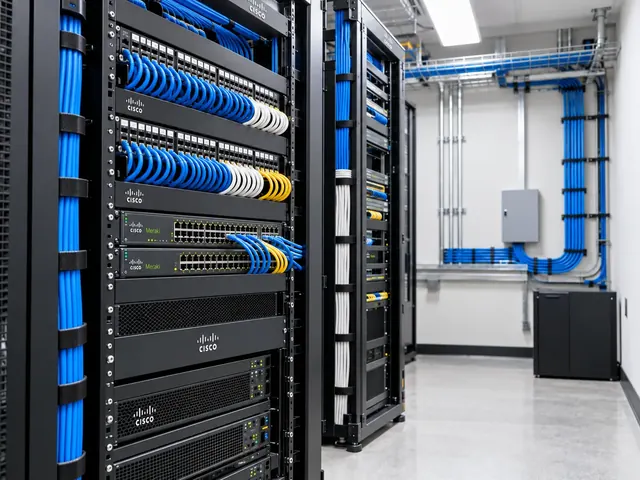
Devices supported
across the UK
Client locations
supported
Traffic handled
at peak time
Average
response time
Average response is not a resolution time or a contractual guarantee. Support scope and response commitments are agreed for each engagement.
Cisco EVPN border leaf integration connects an overlay fabric to networks that do not share its internal operating model. WAN routers, firewalls, cloud gateways and partner services need explicit route and security boundaries. MCI Network Services designs and implements supported Cisco border arrangements with clear prefix ownership and failure behaviour. We verify the complete application path rather than assuming that a fabric is ready once it can establish an external routing neighbour.
Workload-led design
Start with application, compute and storage dependencies rather than the switch model.
Clear failure domains
Understand which links, devices and sites can fail together.
Operational clarity
Make fabrics, external routing and management responsibilities supportable.
Define the external connections and their purpose
We identify each handoff, its owner and the services it must carry. An internet exit, private WAN and customer interconnect may have different policy and availability requirements. The design records expected prefixes, traffic direction and any restriction on transit between external networks. These requirements are agreed before choosing a common border configuration for all connections.
The assessment includes existing firewalls, address translation and application allowlists. A new border path can change source addresses or return routing even when workload addresses remain the same. We involve the relevant application and security teams so that network acceptance is tied to usable services rather than only to route-table entries.

Standards & partnerships
Confidence in the team behind your network.
 Cisco Partner
 Cisco Meraki
 Cyber Essentials
 Cyber Essentials Plus
MCI Network Services is operated by Proxar Ltd. Certifications apply to the certified legal entity and the scope of its certificates. View accreditation information
Select supported border roles and platform capabilities
Border functions must fit the selected Cisco hardware, software and fabric design. We review routing scale, interface capacity and the interaction with tenant and overlay features. A switch suitable as an ordinary leaf may have different practical constraints when it also carries large external route sets or aggregates several services.
Physical design includes cabling, power, upstream diversity and capacity after a failure. The border should not silently become the single constrained path for an otherwise well-provisioned fabric. We document the expected traffic and growth assumptions, including any limitation in the surviving state. Device counts alone are not used as evidence of resilience.

A useful starting point
Not sure where to start?
Bring the requirement. We will help you define the engineering work.
Control route exchange at the boundary
We define which tenant prefixes are exported, which external routes are imported and how defaults or summaries are handled. The policy must avoid unintended transit and route feedback. Where multiple routing domains meet, redistribution or other route exchange is kept narrow and testable. Each boundary has a clear owner who can approve new advertisements.
The overlay and external routing views are compared explicitly. A route can exist on a border device without being available to the intended tenant, or be imported more widely than required. We verify the relevant identifiers and policy rather than assuming that a healthy neighbour means the right information has reached every necessary forwarding point.

Different environments. The same care.
Built around the work
your network supports.
Finance, banking and the wider private sector. We start with the systems and people that depend on your connections.
Finance & banking
Market-data paths, routing and provider coordination on clients’ behalf.
Financial-market services ↗Offices & multi-site teams
Reliable access between people, workplaces and business applications.
Office network design ↗Data centres & cloud
Network boundaries, workload connections and operational ownership.
Data centre networks ↗Integrate stateful inspection and shared services
Firewalls and other stateful services may require a consistent traffic path. We trace the forward and return route, including the effect of a border or upstream failure. An available alternate path is not useful if it bypasses a required control or sends return traffic through a device with no corresponding session state.
Shared services are designed with tenant separation in mind. We identify which networks need access and where enforcement occurs. The presence of a common border does not authorise broad route leaking between tenants. Any translation or service insertion is documented with its supported configuration and operational owner, keeping the security model understandable during later changes and incidents.

Implement with coordinated validation
The change plan includes configuration review, remote-team participation, pre-change evidence and rollback conditions. We introduce routing and traffic in controlled stages, comparing expected advertisements with the information actually accepted at both ends. External dependencies are verified before production workloads rely on the new border path.
Acceptance includes representative application transactions, prohibited paths and agreed failure cases. We observe restoration as well as failover, because the return of a preferred route can expose inconsistent policy or cause a second session interruption. Tests that cannot safely be performed are recorded as limitations. The customer receives an evidence-based handover rather than a general claim of seamless external connectivity.

Make the border service maintainable
The final records identify interfaces, neighbours, prefix policies, security paths and escalation contacts. Monitoring should reveal lost redundancy, unexpected route counts and important service failures. Future additions to the fabric or external network follow the same route-ownership review rather than expanding filters informally during an urgent change.
MCI can integrate a new Cisco EVPN fabric, add an external service or troubleshoot a border-related fault. The work connects with our EVPN architecture service and BGP routing support. Provide the fabric topology, external handoffs and required application flows to begin. We will define the supported border design and the participation needed from adjacent network and security owners.

Talk to a specialist
What does your network need next?
Tell us what you are planning, changing or trying to improve. We will help define a practical next step and the engineering scope.
+44 203 196 6566Choose option 1
sales@proxar.co.ukUK-wide service.
Most of our engineers are based in Kent, with a focus on London, Sussex, Essex and Berkshire.
Existing customers should use their agreed support and escalation channels. This form is for service enquiries, not a monitored emergency ticket.
Tell us what you need.
A short outline is enough. Please do not include passwords or sensitive network details.
Thank you. Your enquiry has been submitted.
Please check your name, email and message, then try again.
Your form session expired. Please try again.
Please wait a minute before sending another enquiry.
We could not submit your enquiry. Please call or email us instead.