
Connect. Secure. Manage.
Juniper Network Integration
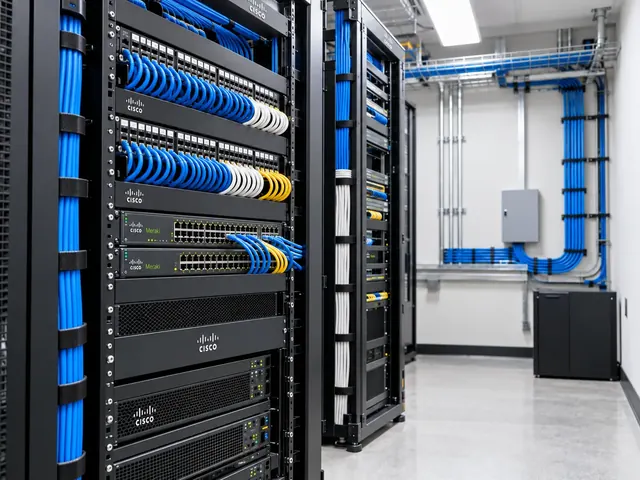
Integrate existing Juniper routing or switching with Cisco networks, reviewing protocol compatibility, addressing and responsibility at the shared boundary.
Devices supported
across the UK
Client locations
supported
Traffic handled
at peak time
Average
response time
Average response is not a resolution time or a contractual guarantee. Support scope and response commitments are agreed for each engagement.
Juniper network integration helps organisations connect retained Juniper infrastructure to a Cisco-led environment with clear routing, switching and support boundaries. MCI focuses on the points where the platforms meet: the traffic that must pass, the controls that must remain in place and the behaviour expected when something changes or fails.
You may be linking an acquired business, retaining a provider-facing router or introducing Cisco equipment alongside an established Juniper estate. The right design depends on the role of each system. We assess that role before proposing configuration changes or replacement hardware.
A clear requirement
Turn the business need into a practical network scope with visible dependencies.
A controlled delivery
Plan implementation, testing and rollback before production changes begin.
A supportable result
Leave useful records, ownership and escalation routes behind.
Identify the exact Juniper role
A device at a carrier handoff presents a different requirement from a switch in the access network. We establish the platform, software, current configuration and administrative owner, together with the applications that depend on it.
The project also needs a clear reason for the integration. Maintaining an existing commercial arrangement, preserving a specialist function and preparing a future migration are all valid aims, but they lead to different acceptance criteria.
Where records are incomplete, discovery is part of the scope. We do not assume that an interface description or old diagram accurately represents the live boundary without checking useful evidence.

Standards & partnerships
Confidence in the team behind your network.
 Cisco Partner
 Cisco Meraki
 Cyber Essentials
 Cyber Essentials Plus
MCI Network Services is operated by Proxar Ltd. Certifications apply to the certified legal entity and the scope of its certificates. View accreditation information
Agree how the networks exchange reachability
For a routed connection, the design identifies address ownership, permitted route exchange and the intended return paths. Any dynamic routing arrangement needs explicit policy rather than an assumption that each side should accept whatever the other advertises.
For a switched connection, the relevant VLAN, loop-prevention and link arrangement must be checked against the actual platforms. Similar terminology does not remove the need to understand how the configuration behaves.
Management and monitoring access are considered separately from business traffic. An integration should not unintentionally extend administrative reach simply because two production networks now communicate.

A useful starting point
Not sure where to start?
Bring the requirement. We will help you define the engineering work.
Examine recovery at the shared boundary
A retained Juniper system may already participate in a resilience design. Connecting a new platform can alter the path selected during a failure or expose a dependency that was not previously important.
We identify the failure conditions that matter to the service and agree how they can be tested safely. The question is not only whether another link remains up, but whether the required traffic can still reach the right destination and return.
Where live failure testing is not permitted, the limits of the assessment are recorded. Configuration review can support a design judgment without being presented as proof of an unperformed production test.

Different environments. The same care.
Built around the work
your network supports.
Finance, banking and the wider private sector. We start with the systems and people that depend on your connections.
Finance & banking
Market-data paths, routing and provider coordination on clients’ behalf.
Financial-market services ↗Offices & multi-site teams
Reliable access between people, workplaces and business applications.
Office network design ↗Data centres & cloud
Network boundaries, workload connections and operational ownership.
Data centre networks ↗Coordinate implementation between teams
Access and change authority need to cover both sides of the integration. If your Juniper platform is managed by a carrier or another specialist, its lead times and approval process form part of the plan.
We prepare the intended changes, validation sequence and recovery conditions. A maintenance window should not be spent discovering that the other party uses a different addressing plan or has not approved the required policy.
For an integration that is part of a wider transition, network migration planning can establish the temporary and final states. The retained boundary may need different settings at different stages, which must be documented explicitly.

Make the mixed estate supportable
The handover records the interface between the environments, agreed route or VLAN behaviour and the tests performed. Operational contacts and responsibility for future changes should be easy to find.
Monitoring should help both teams distinguish a local device issue from a failure across the handoff. Useful evidence reduces the risk of incidents being passed back and forth without anyone owning the combined service.
For Cisco and Meraki network services involving a Juniper boundary, use our contact page to describe the platforms, connection purpose and current owners. We can then scope a review or implementation around the real dependency.

Juniper integration questions
Can the Juniper equipment remain in service?
It may be appropriate to retain it where capability, support status and the proposed design are suitable. That decision follows an assessment. Integration is not a promise that every existing platform should remain indefinitely or that replacement is always unnecessary.
Will you translate the configuration line by line?
Not as the basis for design. The important task is to understand the intended behaviour and implement a supported equivalent where available. A line-by-line translation can miss differences in defaults, policy handling or operating assumptions.
Can our carrier keep managing its router?
Yes, where the boundary and change process are agreed. The carrier can retain responsibility for its equipment while MCI works on the customer network. Joint testing and a clear escalation route are important when neither party controls the whole path.
What information is needed initially?
Provide the platform names, connection purpose and a high-level outline of the current arrangement. Detailed configurations and credentials should follow through an approved secure route. For an uncertain estate, an architecture review may be the best first step.
Talk to a specialist
What does your network need next?
Tell us what you are planning, changing or trying to improve. We will help define a practical next step and the engineering scope.
+44 203 196 6566Choose option 1
sales@proxar.co.ukUK-wide service.
Most of our engineers are based in Kent, with a focus on London, Sussex, Essex and Berkshire.
Existing customers should use their agreed support and escalation channels. This form is for service enquiries, not a monitored emergency ticket.
Tell us what you need.
A short outline is enough. Please do not include passwords or sensitive network details.
Thank you. Your enquiry has been submitted.
Please check your name, email and message, then try again.
Your form session expired. Please try again.
Please wait a minute before sending another enquiry.
We could not submit your enquiry. Please call or email us instead.